The 5-Step Token Design Framework Every Serious Builder Needs Before Launch
Regulators under MiCA, VARA, and CBB now require documented token economic models for VA and VASP licences. Here is the 5-step framework that separates engineered token economics from speculative noise.
Ashish Homkar
Founder & CEO · March 17, 2026 · 7 min read
Token design is no longer just a technical or marketing exercise. Regulators across jurisdictions -- from the EU's MiCA to Dubai's VARA to Bahrain's CBB -- are increasingly requiring documented, defensible token economic models as part of Virtual Asset and VASP licence applications.
This framework is for builders who want to design token economics that are rigorous enough to survive both regulators and markets. Five steps. Before launch. Before marketing. Before valuation discussions.
Why Regulators Now Care About Token Economics
The regulatory landscape for virtual assets has matured significantly. Token economic models are now scrutinised under multiple frameworks globally: MiCA (EU), VARA (Dubai), CBB (Bahrain), MAS, ADGM, FSA, and more.
What regulators are looking for is not creative writing. They want to see:
A clearly defined economic function
Controlled and transparent supply mechanics
Incentive structures that do not concentrate extraction in the hands of insiders
Stress testing against adverse conditions
The 5-Step Token Design Framework
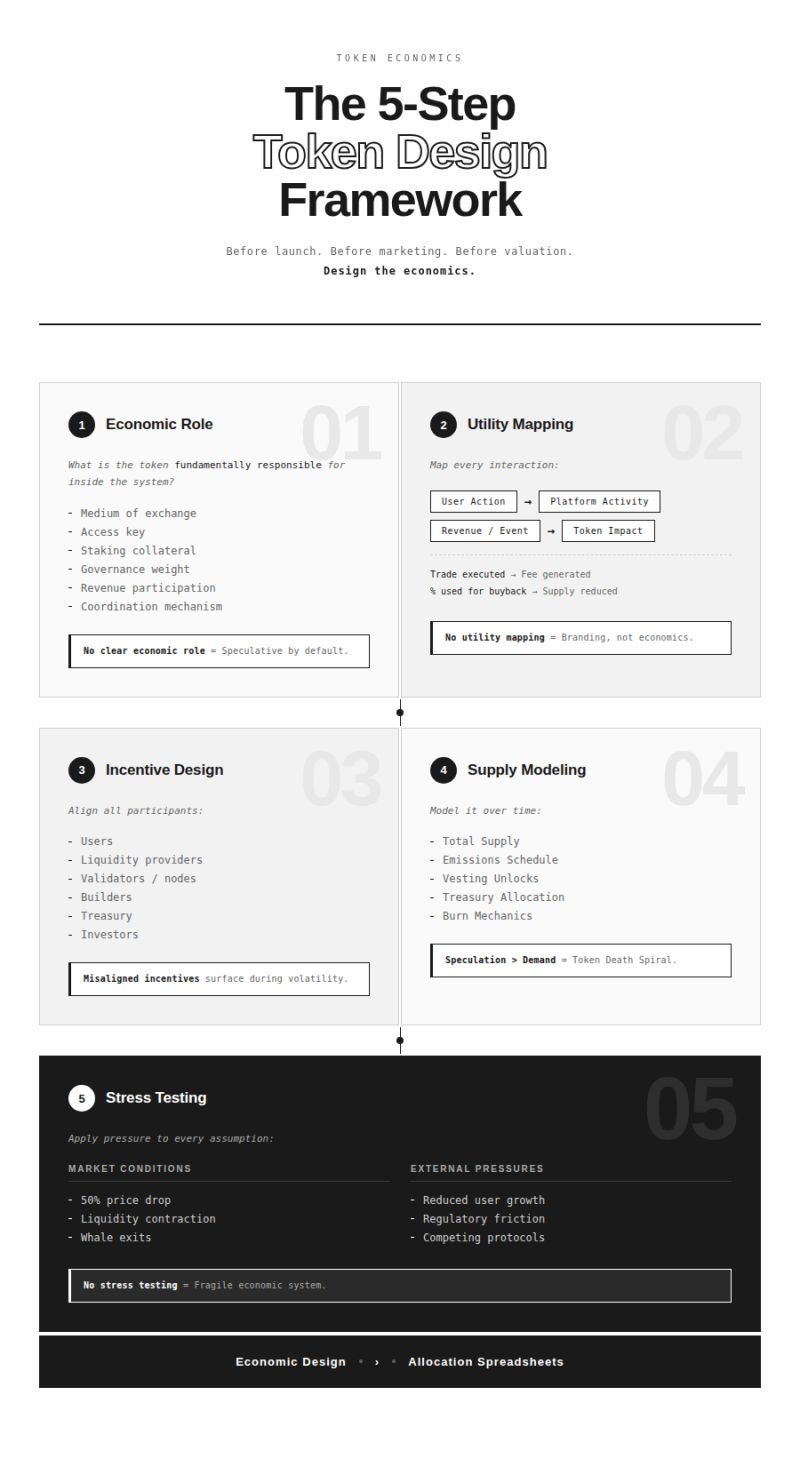
Step 1 — Economic Role
What is the token fundamentally responsible for inside the system?
This is the foundational question and it must be answered with precision. A token can serve one or more of the following functions, but each must be structurally enforced by the system, not just described in documentation:
Medium of exchange | Access key | Staking collateral | Governance weight | Revenue participation | Coordination mechanism
If skipped: No clear economic role = speculative by default
Step 2 — Utility Mapping
Can you diagram every interaction between user activity and token impact?
Utility mapping requires tracing every meaningful user action through to its effect on the token. The structure is:
User action → Platform activity → Revenue or event → Token impact
Example: Trade executed → Fee generated → Percentage used for buyback → Supply reduced.
If you cannot draw this map for your token, you do not have utility. You have branding.
If skipped: No utility mapping = branding, not economics
Step 3 — Incentive Design
Who earns, who pays, who benefits long-term, and who can extract short-term?
Every participant in your ecosystem has a different incentive structure. Incentive design is the process of aligning them so that the behaviours you want -- liquidity provision, long-term holding, active governance -- are the most economically rational choices for each participant type.
Misaligned incentives rarely surface in a bull market. They surface during volatility and bear cycles.
Participant groups to design for: Users | Liquidity providers | Validators / nodes | Builders | Treasury | Investors
If skipped: Misaligned incentives surface during volatility
Step 4 — Supply Modelling
What does circulating supply look like at 10,000 users? At 50,000? During a market downturn?
Supply modelling is where token economics becomes quantitative. You are building a simulation of how total supply, emissions, vesting unlocks, treasury allocation, and burn mechanics interact over time, then running that simulation against adoption scenarios and market conditions.
The most common failure mode: emission rate exceeds demand growth.
Elements to model: Total supply | Emissions schedule | Vesting unlocks | Treasury allocation | Burn mechanics
If skipped: Speculation exceeding demand = token death spiral
Step 5 — Stress Testing
Does the system survive when things go wrong?
A token model that only works in favourable conditions is not a model -- it is an assumption. Stress testing applies adverse pressure to every key variable and asks whether the economic system remains functional.
Market conditions to test: 50% price drop | Liquidity contraction | Whale exits
External pressures to test: Reduced user growth | Regulatory friction | Competing protocols
If skipped: No stress testing = fragile economic system
Allocation Spreadsheets Are the Last Step, Not the First
One of the most persistent misconceptions in token design is treating the allocation table as the tokenomics document. The allocation is the output of the economic design process, not the starting point.
Token design is economic engineering. Design the system first. The allocation table follows from what the system requires -- not from what founders and investors want to receive.
Frequently Asked Questions
What is a token economic model and why do regulators require it?
A token economic model defines how a token functions within its ecosystem: its economic role, utility mechanics, incentive structures, supply dynamics, and resilience under stress. Regulators under MiCA, VARA, CBB, and other frameworks require these models as part of VA and VASP licence applications.
What is utility mapping in tokenomics?
Utility mapping traces every significant user action through to its impact on the token via platform activity, revenue generation, or protocol events. It produces a diagram showing that token demand is structurally tied to ecosystem activity.
What does token stress testing involve?
Token stress testing applies adverse scenarios to the economic model to determine whether the system remains functional. Key questions include whether the treasury lasts 24 to 36 months and whether participant incentives remain aligned under pressure.
What is the token death spiral and how is it avoided?
A token death spiral occurs when token emission consistently exceeds genuine demand. This creates structural sell pressure that compounds over time, driving the price down and eventually collapsing the token entirely. It is avoided through supply modelling before launch.
When should token allocation be decided in the design process?
Allocation should be the final step in the token design process, not the first. Economic role, utility mechanics, incentive structure, and supply model must all be defined before allocations are set.
What is the difference between a token whitepaper and a token economic model?
A whitepaper is a narrative document describing a project's vision, technology, and token mechanics. A token economic model is a quantitative, stress-tested framework covering supply dynamics, incentive alignment, utility flows, and scenario analysis. Regulators reviewing VA licence applications are looking for the latter.