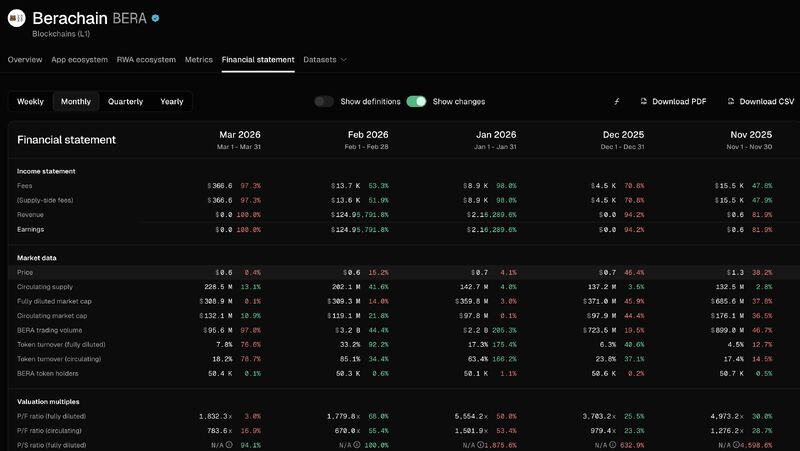
Berachain raised $142M, launched with record testnet numbers, and watched farmers leave the moment emissions slowed. This isn't a Berachain problem — it's a design problem. And it starts in the tokenomics.

Ashish Homkar
Founder & CEO · March 17, 2026 · 5 min read
Berachain raised $142M. Launched with record-breaking testnet numbers. Hundreds of thousands of wallets. Developer buzz everywhere. The narrative was airtight.
Then mainnet launched. TVL spiked. BGT emissions started flowing.
And then the farmers left.
Because that's what you built. A farm.
There's a pattern that repeats itself across every cycle: a well-funded project launches with strong optics — high TVL, active wallets, trending on every crypto dashboard — and then quietly collapses once the emissions dry up.
It's not a marketing failure. It's an economic design failure.
Berachain's Proof of Liquidity (POL) mechanism was genuinely innovative. The separation of BGT (non-transferable governance token) from BERA (gas token) was a thoughtful attempt at aligning liquidity with governance. The problem wasn't the mechanism. It was the question nobody stress-tested before launch:
What happens when you stop paying people to use it?
An airdrop gives you 300,000 wallets in 90 days. It looks incredible on a dashboard. Gets you a Forbes mention. Your investors are happy.
But those 300,000 wallets came for the token. Not for your product.
The moment emissions slow — and they always do — the TVL chart tells you exactly what those participants thought of your protocol. They thought it was a farm. Because you designed it like one.
Berachain's February revenue figures weren't a surprise to anyone who looked at the token model with fresh eyes. When the primary utility is staking to earn emissions, and there's no secondary value loop that functions without those emissions, you don't have a protocol. You have a temporary incentive structure dressed up as one.
This is not a Berachain-specific critique. It applies broadly. Most DeFi protocols that launched in 2023–2024 face the same structural question and very few have a good answer.
This isn't a question for after launch. It's the question you answer before you write a single line of smart contract code.
How does your protocol generate real economic activity that justifies the token's existence independent of emissions?
If the answer involves the words "yield," "emissions," or "incentivised liquidity" and nothing else — your tokenomics aren't finished.
A few diagnostic questions worth asking before any TGE:
Think of it like a quick commerce startup posting impressive GMV numbers while burning cash on every order. The metric looks great until you ask about unit economics.
In crypto, replace GMV with TVL and replace unit economics with protocol revenue per dollar locked. The math usually isn't pretty.
As Martin Pokorski put it: if someone doesn't want your product in real life, they won't want it on-chain either. Tokenization doesn't fix a broken value proposition. It just makes it tradable.
If you're 3–9 months from a token launch, the Berachain situation is a data point worth studying carefully. The lesson isn't "don't build on-chain incentive systems." The lesson is:
Berachain still has time to evolve. The protocol mechanics are real and the team is capable. But the February revenue number is a forcing function — a clear signal that the flywheel hasn't closed yet.
For every project launching in the next 12 months: this is the conversation to have before you set your emission schedule, not after.