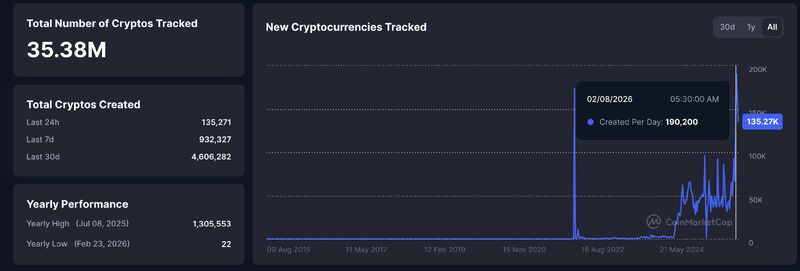
135,000+ tokens launch every day. 99.99% won't survive. The uncomfortable truth is that most founders don't need a token — they need an excuse to raise capital. Here's the honest framework for knowing when tokenization actually makes sense.

Ashish Homkar
Founder & CEO · March 17, 2026 · 6 min read
Over 135,000 tokens are launched every day. The vast majority will not survive twelve months. Most won't survive six.
This isn't a new observation. What is worth examining is why — and specifically, why founders continue to launch tokens when their projects don't structurally require them.
The uncomfortable answer: most founders don't need a token. They need an excuse to raise capital.
From 2017 to roughly 2024, the crypto fundraising playbook was consistent:
It worked. Not because the tokens had economic merit, but because the market was in a phase where narrative preceded fundamentals. Retail capital was abundant, regulatory scrutiny was minimal, and the cycle rewarded early movers regardless of underlying quality.
That phase is over.
Markets are maturing. Institutional investors have seen enough failed models to ask harder questions. Retail participants are more cautious after multiple cycles of watching emissions-driven projects collapse. And regulators in major markets — Dubai, Europe, Bahrain, Singapore, Hong Kong — are actively reviewing token issuance.
The question capital is now asking: what is the real business here?
Capital flows have shifted. Projects that attract serious investment in the current environment share a common profile:
When a business is fundamentally sound, the need for a token becomes strategic. The token serves the business model. It doesn't substitute for one.
This is the reframing that matters most: a token is an economic coordination mechanism, not a capital raise vehicle.
Those are different things with different design requirements.
A fundraising tool is designed to attract capital at a specific moment. An economic coordination mechanism is designed to align distributed participants over time. The second requires far more structural rigor than the first — and most projects skip it entirely because the first was all they needed.
If your project:
You probably shouldn't tokenize. The token will not create those properties. It will only make the absence of them more visible.
That said, there are categories where tokens solve real coordination problems that traditional equity cannot.
DePIN (Decentralised Physical Infrastructure Networks) Physical infrastructure — wireless networks, energy grids, storage networks — requires coordinating thousands of independent operators. Token-based incentive design can align participants who would otherwise have no shared ownership or governance structure.
Energy markets Distributed energy production and consumption creates settlement and coordination challenges that existing financial rails handle poorly. Token-based clearing systems have genuine structural advantages here.
Data marketplaces When data has value but privacy prevents centralised aggregation, token-coordinated data markets create incentive structures that protect contributors while enabling buyers.
AI coordination layers Compute, model training, and inference coordination across distributed contributors benefits from programmable incentive design — particularly where contributions are verifiable on-chain.
Cloud compute networks Similar to DePIN: aligning distributed compute providers requires coordination mechanisms that equity cannot replicate.
Privacy infrastructure Privacy-preserving protocols often require economic incentives for participation that only work if the coordination layer itself is trustless.
In each of these cases, the token does something that equity cannot: it aligns distributed, anonymous participants around a shared economic outcome without requiring a central coordinator or trust relationship.
That's the bar. If your token doesn't clear it, the token isn't doing structural work.
The current market is producing 135,000+ tokens per day. The signal-to-noise ratio is essentially zero. In that environment, not launching a token when you don't need one is a strategic differentiator.
It tells serious capital: we're building a real business. We're not spray-and-praying.
It reduces regulatory risk. It reduces the complexity of your cap table. It forces you to focus on product-market fit rather than token-market fit — which is a distraction from the underlying business.
Some of the best companies in Web3 are not tokenized. Some will eventually tokenize when the structural case is clear. The sequence matters: build the business that justifies the token, not the token that needs the business to justify it.
Before any token launch discussion, every founder should be able to answer:
Why does this specific product, at this specific stage, for these specific participants, require a token to function?
Not "why would a token help our marketing?" Not "why would a token enable a raise?" Not "what's the token's utility?" — which is often reverse-engineered from the decision to launch.
Why is a token structurally necessary for this system to work?
If the answer is clear and specific, build the token model carefully, test it thoroughly, and launch when it's ready.
If the answer isn't clear, you're building the business. Which is the right thing to be doing.
Blockphrase advises pre-TGE projects on token economic design and regulatory-compliant white paper development. If you're working through this question, you can reach us at blockphrase.com.