Loading article…
Back to Blog
Strategy
The Token Supply Crisis of 2026 is not a Market Problem. It is a Design Problem.
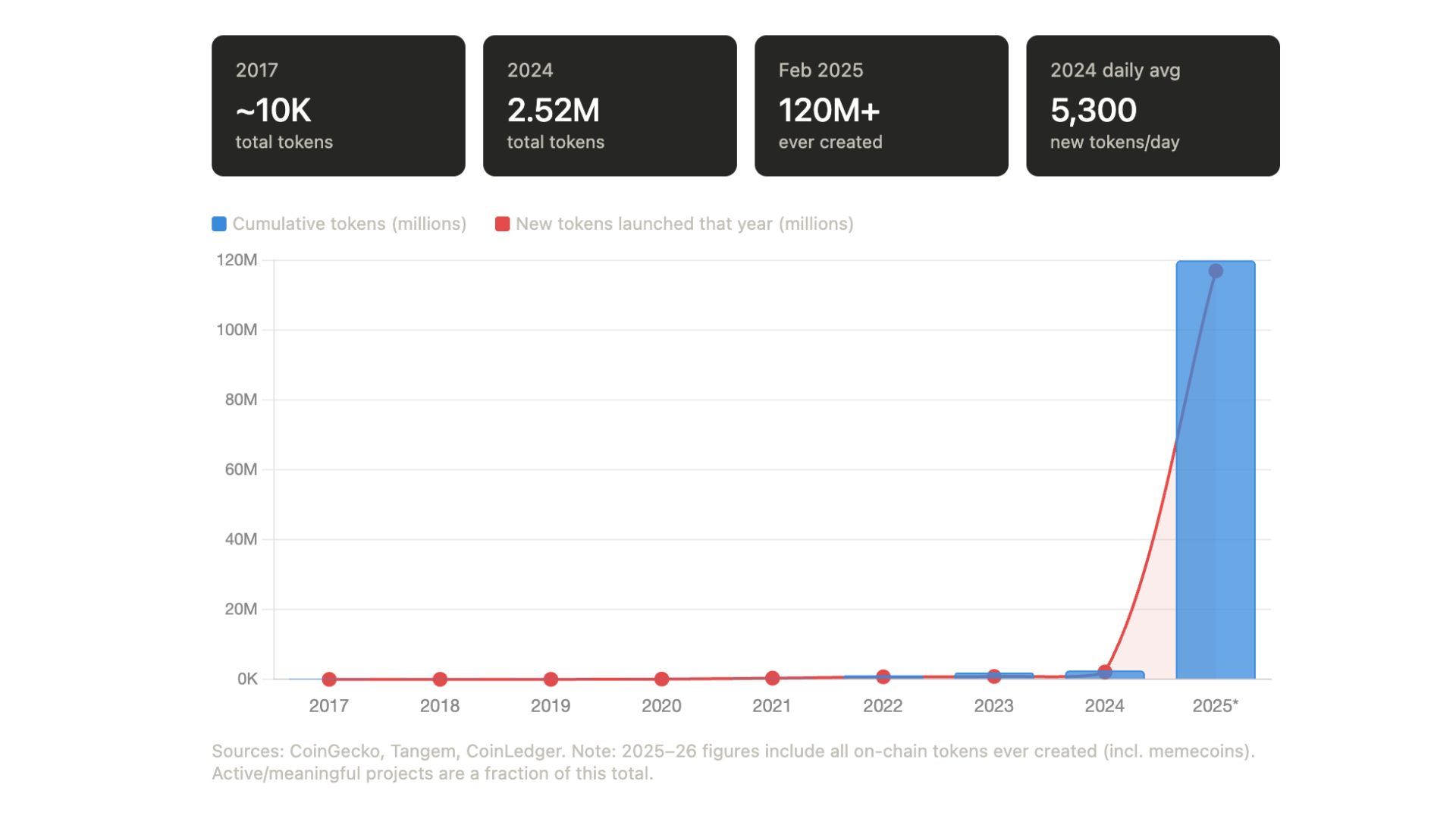
In the first two months of 2026 alone, over 540,000 new tokens were launched across Ethereum, Solana, and Base. However only 0.1% will survive.
B
Blockphrase Team
Admin · March 19, 2026 · 3 min read
In the first two months of 2026 alone, over 540,000 new tokens were launched across Ethereum, Solana, and Base.
Let that number settle for a moment.
That is not a signal of innovation. That is a signal of a broken incentive structure, one where the barriers to launching a token have collapsed entirely, while the standards for designing one responsibly have not kept pace.
The Copy-Paste Problem
Scroll through the whitepapers of most tokens launched this cycle and you will find a striking uniformity. Thirty percent allocated to the founding team. A two-year vesting schedule. Twenty percent reserved for presale investors. A "community rewards" bucket added as an afterthought. In many cases, the whitepaper itself was written after the fundraise was already complete.
What you will rarely find is evidence that anyone stress-tested the supply schedule. That anyone modelled the token's behaviour at the vesting cliff. That anyone asked the most fundamental question a token designer can ask: what does "working" actually mean for this specific token, in this specific market, with this specific user base? This is not a minor oversight. It is the root cause of the token supply crisis playing out across the market in 2026.
Misdiagnosing the Problem
The prevailing narrative attributes this cycle's underperformance to macro conditions: rising rates, risk-off sentiment, a pullback in speculative capital. These factors are real. But they are not the primary cause. The primary cause is structural. Thousands of tokens were designed not as economic infrastructure but as fundraising instruments. Their tokenomics were optimised for one moment: the launch. What happened in the months and years after, the cliff events, the sell pressure, the liquidity erosion, was either not modelled or not disclosed. When poorly designed tokens flood the market at scale, the consequences are not contained to the individual projects. They erode trust across the entire asset class, compress valuations for legitimate projects, and make institutional capital allocation significantly harder to justify.