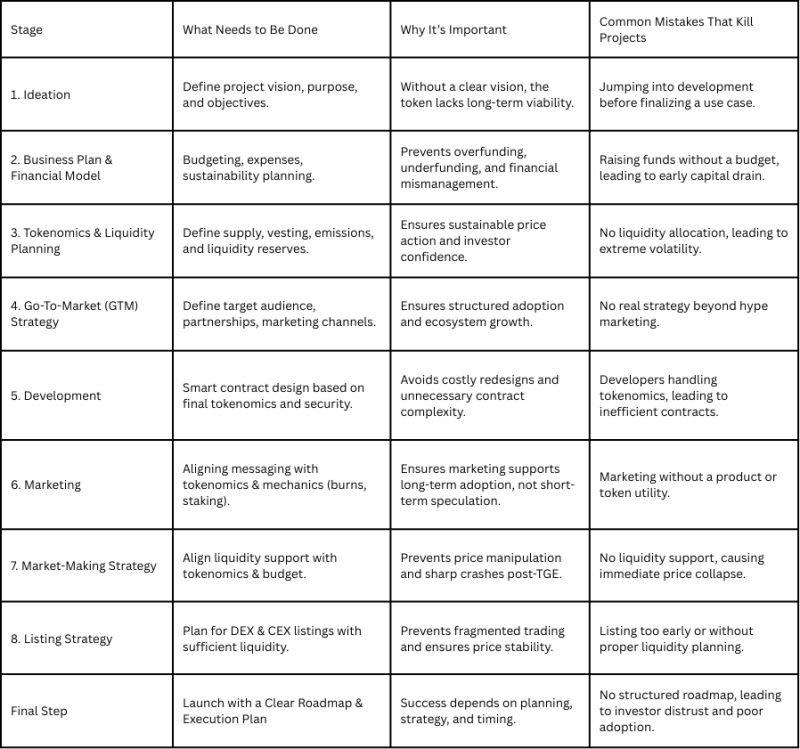
Most crypto projects overpay or get scammed because they skip the fundamentals. Here is the exact 8-stage chronology every token project must follow before writing a single line of smart contract code.

Ashish Homkar
Founder & CEO · March 17, 2026 · 7 min read
Launching a cryptocurrency token is not a development problem - it is a strategy problem. Yet the majority of founders rush to hire developers before they have defined a single business objective, designed tokenomics, or allocated a realistic budget. The result? Costly re-works, security vulnerabilities, investor distrust, and in many cases, projects that get scammed or quietly collapse under financial pressure.
At Blockphrase, we have worked with enough token projects to recognise a clear pattern: the ones that fail almost always get the order of operations wrong. This guide lays out the correct chronology and explains what goes wrong at each stage when it is skipped.
The first three stages are non-negotiable. Everything downstream depends on them.
| Stage | What needs to be done | Why it matters | Common mistake |
|---|---|---|---|
| 1. Ideation | Define project vision, purpose, and objectives | Without a clear vision, the token lacks long-term viability | Jumping into development before finalising a use case |
| 2. Business plan & financial model | Budgeting, expenses, sustainability planning | Prevents overfunding, underfunding, and financial mismanagement | Raising funds without a budget, leading to early capital drain |
| 3. Tokenomics & liquidity planning | Define supply, vesting, emissions, and liquidity reserves | Ensures sustainable price action and investor confidence | No liquidity allocation, leading to extreme volatility |
| 4. Go-to-market strategy | Define target audience, partnerships, marketing channels | Ensures structured adoption and ecosystem growth | No real strategy beyond hype marketing |
| 5. Development |
| Smart contract design based on final tokenomics and security |
| Avoids costly redesigns and unnecessary contract complexity |
| Developers handling tokenomics, leading to inefficient contracts |
| 6. Marketing | Align messaging with tokenomics and mechanics | Ensures marketing supports long-term adoption, not short-term speculation | Marketing without a product or token utility |
| 7. Market-making strategy | Align liquidity support with tokenomics and budget | Prevents price manipulation and sharp crashes post-TGE | No liquidity support, causing immediate price collapse |
| 8. Listing strategy | Plan for DEX and CEX listings with sufficient liquidity | Prevents fragmented trading and ensures price stability | Listing too early or without proper liquidity planning |
Smart contracts must be expressions of your tokenomics - not the other way around. When development starts before tokenomics are finalised, two things happen:
Starting development before tokenomics is like designing a building's plumbing before the architect has drawn the floor plan. You will knock it out and redo it.
One of the most expensive mistakes we see is conflating roles. There are three distinct disciplines in a token launch, and they should not be handled by the same person.
Tokenomics design is an economic and financial discipline. A tokenomics designer must understand supply-demand dynamics, vesting cliff psychology, inflation modelling, and liquidity provisioning. This is not a developer skill.
Smart contract development is a technical discipline. Developers implement what the tokenomics design specifies. When developers also design tokenomics, they default to what is technically easy to build, not what is economically optimal for the project.
Market-making strategy sits at the intersection of finance and operations. A market-making strategy must be calibrated to your tokenomics, budget, and GTM timeline. It is not a marketing function, and it is not a development function.
What is the correct order of stages for a crypto token launch?
The correct sequence is: Ideation, Business plan and financial model, Tokenomics and liquidity planning, Go-to-market strategy, Development, Marketing, Market-making strategy, then Listing strategy. The first three are non-negotiable and must be completed before any other stage begins.
Why should smart contract development come after tokenomics?
Smart contracts must reflect the final tokenomics design. Starting development early means building on assumptions that will change, resulting in costly contract re-works, security gaps, and inflated development bills.
Can my development team design my tokenomics?
Not recommended. Developers will naturally design token mechanics that are straightforward to implement technically, which often leads to over-engineered contracts that are expensive to audit and maintain.
What is a market-making strategy in crypto and why does it matter?
A market-making strategy defines how liquidity will be provided to support the token's price post-TGE. Without it, even well-designed tokens can collapse immediately after listing due to insufficient buy-side depth.
What is the biggest mistake founders make when launching a token?
The most common mistake is beginning smart contract development before completing ideation, a business and financial plan, and tokenomics. This results in re-works, wasted capital, and projects that are structurally unviable by the time they launch.